
TL;DR: A local citation is any online mention of your business name, address, and phone number, whether that's a directory listing, a map platform, a review site, or a news article. Search engines cross-check those details, so consistent data builds confidence and conflicting data erodes it. Most businesses gain more from fixing broken and duplicate listings than from creating new ones. Quality and relevance beat volume, and the same citation sources now feed AI assistants and voice search.
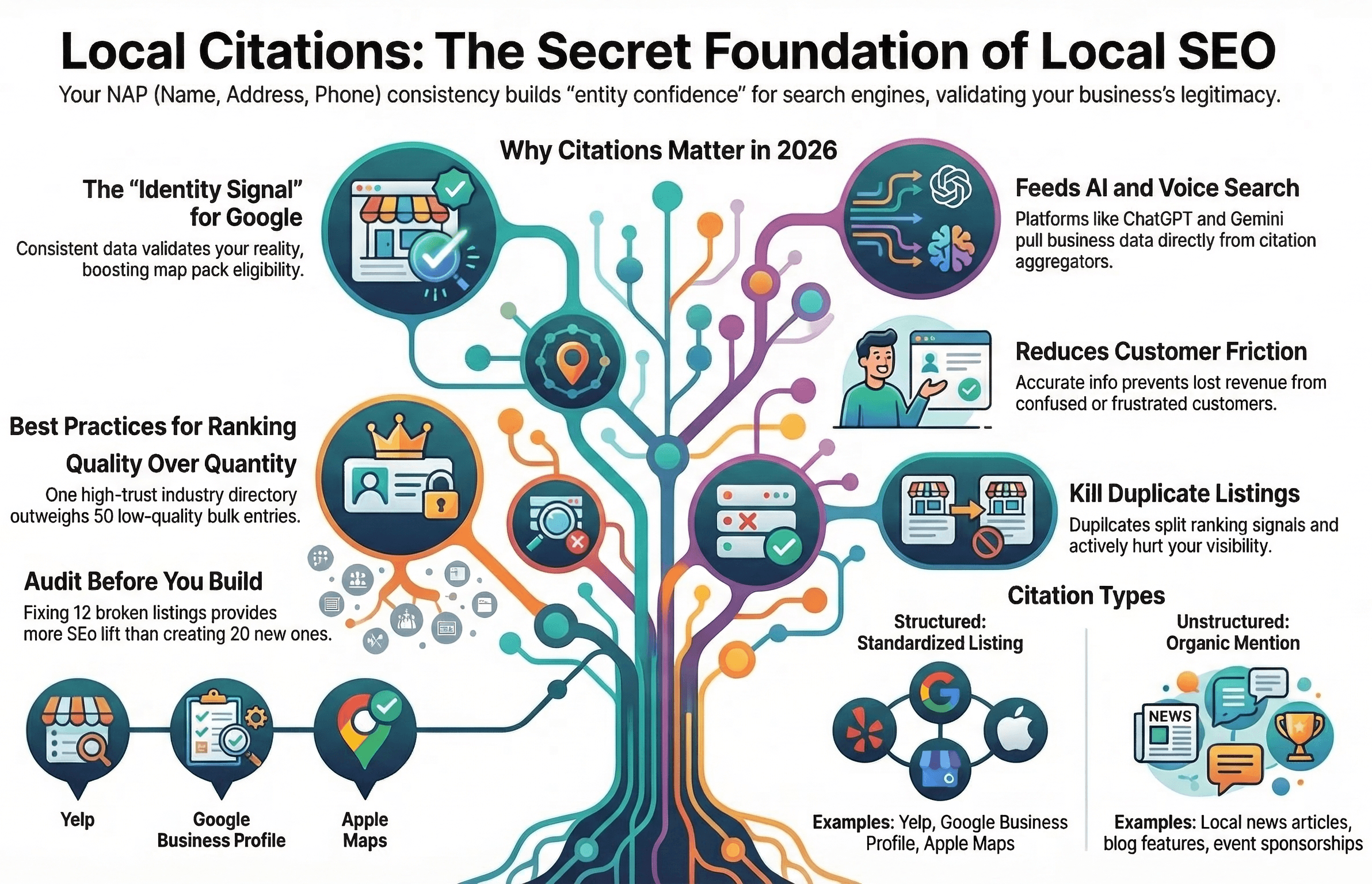
Key takeaways:
- Your name, address, and phone number should match across your website footer, Google Business Profile, and every directory you appear in.
- Citations work as an identity signal. Corroborated data across trustworthy platforms tells search engines your business is verifiable.
- A listing on a respected industry directory or your local chamber of commerce outweighs 50 entries on bulk directories.
- Structured citations (directory listings) and unstructured ones (news mentions, sponsorships, blog features) both count.
- Duplicate listings split your signals and confuse customers. Find them before you build anything new.
- AI assistants and voice search pull from the same citation sources, so messy data means being skipped or described with outdated information.
- Auditing usually outperforms building. Fixing 12 broken listings often beats creating 20 new ones.
Plenty of local SEO problems have nothing to do with your website. They start when Google finds three versions of your business name, two phone numbers, and an address you left four years ago.
A local citation is any online mention of your core contact details, usually your business name, address, and phone number, often shortened to NAP. Many citations also carry your website URL, hours, category, and reviews.
For local businesses, citations are part of the foundation. Search engines use them to confirm your business is real, active, and located where you claim. Customers use them to figure out how to reach you.
Watch the companion video: What local citations do for SEO
What counts as a citation
A citation is a mention of your business information on another website, directory, app, map platform, or social profile. Some include a link to your site, some don't. Both types matter.
Citations show up on Google Business Profile, Apple Business Connect, Yelp, Bing Places, chamber of commerce sites, local directories, industry listing sites, and data aggregators. They also appear in places owners forget entirely: an old supplier page, an event sponsorship listing, a social account nobody has logged into since 2019.
The mechanism is simple. Search engines compare your details across the web. Matching information in multiple reliable places builds confidence. Conflicting information erodes it.
Citations alone won't push you to the top of local results. SEO never works that neatly. But when the foundation is messy, every other local SEO effort has to work harder to overcome it.
Why they matter for rankings and for customers
Local SEO runs on two kinds of confidence at once. Search engines need enough to show your business. People need enough to choose it.
On the ranking side, consistent citations support local relevance and business verification. They connect your website, your Google Business Profile, and your presence elsewhere on the web. In crowded markets, those connections help Google decide who belongs in local results.
On the customer side, citations remove doubt. Someone who finds you on a map app, a directory, and a review site, all showing the same address and phone number, feels comfortable calling. Someone who finds three different closing times and a wrong suite number does not.
For service businesses, that gap costs revenue. A customer who can't confirm how to reach you rarely investigates further.
Structured and unstructured citations
Structured citations live in directories and listing platforms with a standard format. You fill in company name, address, phone, website, category, hours, and often a description and photos. These are the familiar kind and the easiest to manage deliberately: map platforms, review sites, local business directories, industry listing sites.
Unstructured citations appear inside regular web content. A local news article mentions your business and city. A blog post includes your phone number. A chamber article lists you among event sponsors.
Unstructured mentions are harder to control and still valuable, because they confirm your business exists in a specific place and context.
What makes a citation worth having
Accuracy first. Your business name should match the brand you actually use in public. Your address should be formatted consistently. Your phone number should point to the same main line wherever possible. Using "Ste." on one site and "Suite" on another won't sink you, though repeated inconsistency creates noise.
Completeness next. A listing with a name and phone number does less than one with categories, hours, photos, website URL, and a real service description. Complete profiles give search engines and customers more to work with.
Then relevance. A directory for Texas businesses or an industry listing for attorneys, contractors, dentists, or home service providers is worth more than a random directory with no standards and no traffic. Citation count means nothing when the sites are junk.
The problems that hurt local SEO
Inconsistency is the most common. Businesses move, change phone systems, rebrand, or switch websites, and old listings sit there for years. Search engines see conflicting data. Customers call disconnected numbers.
Duplicate listings come second, and they're widespread on Google Business Profile, Yelp, and industry directories. Someone creates a new profile without realizing one already exists, and the ranking signals split between them.
Category mismatch is quieter. One listing calls you a roofing contractor, another says general contractor, a third says home improvement company. Some variation is natural, and your primary service should stay unmistakable.
Bulk submission services are the last trap. Hundreds of directory listings in a few days sounds efficient. Most of those sites have no trust, no moderation, and no users, and now your data is scattered across platforms you can't correct.
Building citations without wasting effort
Start with the platforms that carry weight. Claim and fully complete your Google Business Profile, then work through Apple, Bing, Yelp, and the major directories customers actually use.
Then go after local and industry relevance. A law firm, dental office, HVAC company, or boutique retailer should appear where people in that field expect to find them. A business in Amarillo or Lubbock can also benefit from credible regional directories, chambers, and community organizations when the fit is genuine.
Keep one master version of your business information in a single document: official name, address, phone, website, hours, and short description. That one habit prevents a surprising amount of drift.
And audit before you build. The bigger win is usually fixing the 12 broken listings you already have rather than adding 20 new ones.
Citations compared with backlinks
Owners mix these up constantly.
A backlink is a link from another website to yours, and it mainly signals website authority. A citation is a mention of your business details, and it mainly signals local trust and validation.
Some citations include a backlink, which helps. Plenty don't, and they still count. In local SEO, accurate mentions carry weight with or without a clickable link.
Backlinks are votes for your website. Citations are confirmations of your identity. You want both, and they do different jobs.
How often to audit
At minimum, review your citations any time your core details change: a move, a new phone number, a rebrand, updated hours, a website migration.
Even when nothing changes, run an annual check. Platforms update their data, users suggest edits, and duplicates appear without warning. Multi-location businesses and anyone in a competitive market should look more often.
This is where a lot of local businesses bring in help. Citation management sounds simple until you're chasing outdated listings across dozens of platforms while trying to run the business.
The quiet value
Citations are nobody's favorite part of SEO. They do the unglamorous work that supports visibility, trust, and conversion.
When your citations are accurate, search engines get a clearer picture of your business, customers get fewer reasons to hesitate, your Google Business Profile works harder, and your website stops carrying the whole load alone. Get that right and a lot of other local marketing gets easier.
FAQs
What is a local citation in SEO?
A local citation is any online mention of your business name, address, and phone number. They appear on directories, review platforms, social profiles, maps, and ordinary websites, and they help search engines verify that your business is real and located where you say it is.
What does NAP mean and why does consistency matter?
NAP stands for name, address, and phone number. Those details should be identical across your website footer, Google Business Profile, and every directory. Small variations like "St." versus "Street" or a missing suite number split confidence in your data.
What's the difference between a citation and a backlink?
A citation is a mention of your business details and may or may not include a link. A backlink is a hyperlink from another site to yours. Citations build local trust in your business identity; backlinks pass authority to your website.
Which citation platforms matter most?
Google Business Profile, Apple Maps, Bing Places, Yelp, Facebook, and the data aggregators such as Neustar Localeze, Data Axle, and Foursquare. Beyond those, industry-specific and locally relevant directories carry weight because of the context they add.
How do duplicate listings hurt local SEO?
Duplicates split your citation signals across multiple entries, so search engines can't tell which listing is authoritative. They also send customers to the wrong contact details. Removing or merging duplicates usually improves rankings more than adding new citations.
Do citations affect AI search and voice results?
Yes. AI assistants and voice search pull business data from the same citation sources that feed traditional local SEO. Clean, consistent data makes you far more likely to be surfaced, and accurately described, in those answers.