
TL;DR: NAP consistency means your business name, address, and phone number appear exactly the same everywhere online: your website, Google Business Profile, directories, and social profiles. Matching details tell search engines all those listings belong to one real business, which supports Local Pack and Maps visibility. Conflicting details fragment that trust and quietly cost you rankings and leads. Define one canonical NAP, audit what's out there, fix the high-value listings first, and re-check after every move, rebrand, or phone change.
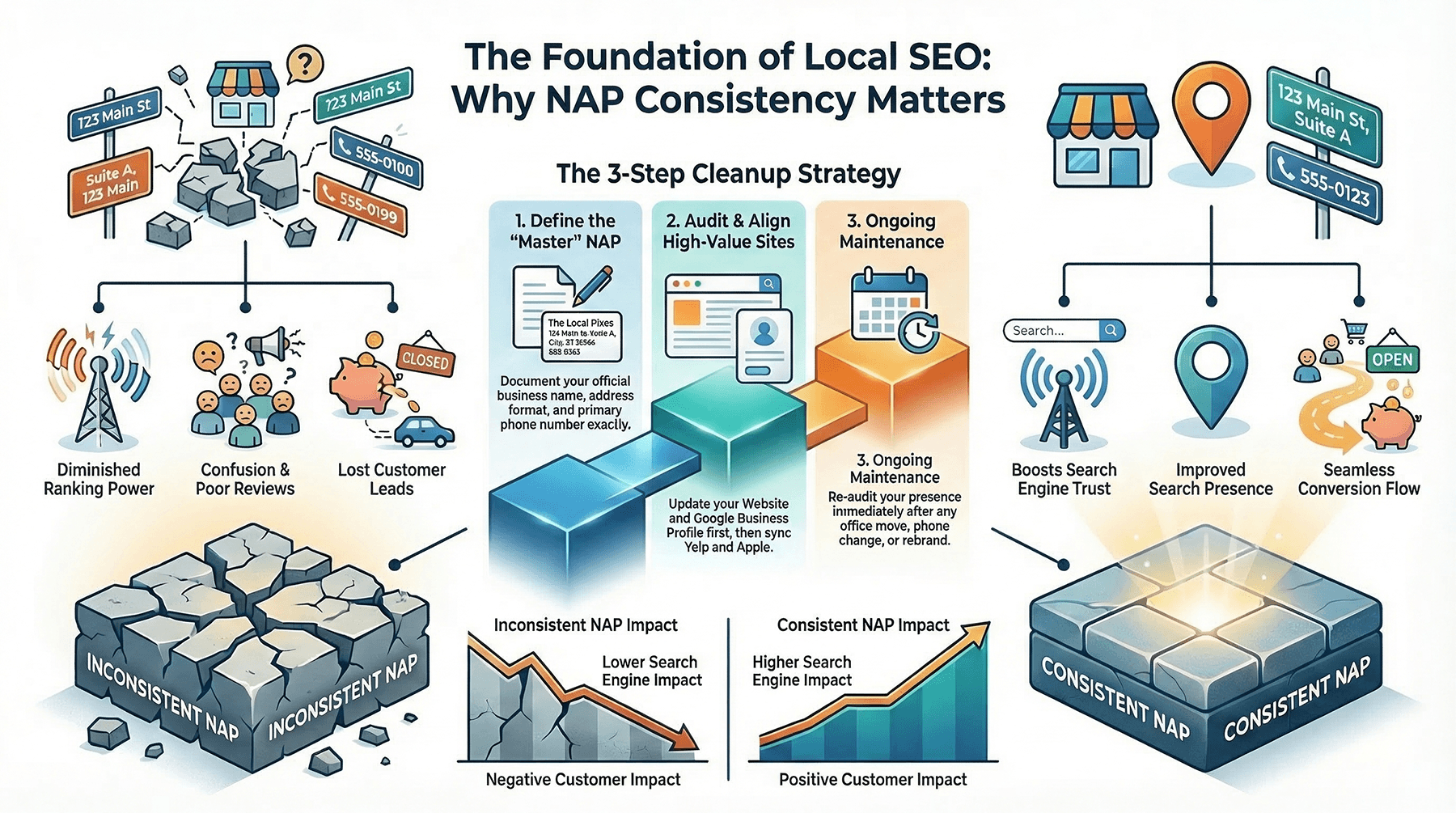
A customer searches for your business and finds two addresses, three phone numbers, and a name variation that looks close enough to be right. That small mess creates a big problem. They may call the wrong number, drive to an old location, or move on to a competitor that looks more reliable.
NAP stands for name, address, and phone number. It sounds basic because it is. But local search depends on basic signals being accurate everywhere your business appears. When search engines find the same core information across your website, Google Business Profile, directories, map listings, and citations, they gain confidence in what to show. When that information conflicts, trust drops.
For small businesses this isn't just an SEO detail. It affects rankings, customer experience, and revenue.
Watch the companion video: Why NAP consistency still matters
What NAP consistency actually means
NAP consistency means your business name, physical address, and phone number appear the same way across the web. Not mostly the same. Not close enough. The same, in the places that matter most.
That includes your website, Google Business Profile, Apple Business Connect, Bing Places, social profiles, data aggregators, chamber listings, industry directories, and any citation source where your business appears.
There's nuance. Search engines handle minor differences better than they used to; "St." versus "Street" won't sink you on its own. But repeated variation creates noise. If you're "Anderson Heating & Air" in one place, "Anderson Heating and Air Conditioning" in another, and "Anderson HVAC" somewhere else, you're asking search engines to make assumptions. Sometimes they do. Sometimes they don't.
That uncertainty weakens local rankings, especially in competitive markets where trust signals need to be clean.
Why inconsistent listings hurt more than most owners realize
The obvious cost is customer confusion: missed calls, failed visits, poor reviews, wasted ad spend. When someone clicks through from a directory and sees a different phone number than your site shows, the disconnect creates doubt.
The SEO cost is less visible but just as real. Local search works by validating business identity across multiple sources. When Google's systems find conflicting details, your listing loses authority against competitors with cleaner profiles.
One typo won't tank your rankings. Local SEO is never that simple. Website quality, reviews, proximity, category relevance, and profile optimization all matter too. But NAP issues chip away at performance in a way many businesses don't notice until growth stalls.
The damage usually starts after a change: a move, rebrand, phone system switch, or website redesign. The homepage gets updated while old directory listings, map citations, and social platforms keep the stale data. Months later rankings slip and lead quality gets messy. The root cause isn't dramatic. It's fragmented business data.
Where your NAP needs to match
Start with the sources that shape visibility and customer action most directly. Your website should display your current name, address, and phone number clearly, ideally in the header, footer, and contact page. Your Google Business Profile must match exactly.
From there, work through the major platforms and trusted citation sites: Bing Places, Apple's business profiles, Yelp, Facebook, and the industry directories your customers actually use. For home services, legal, medical, contracting, and restaurants, niche directories carry extra weight.
Don't ignore old citations just because they send no traffic. Search engines still use third-party references to validate identity, and an outdated profile from years ago keeps creating confusion.
Multiple locations? Each needs its own accurate NAP: a distinct local landing page, matching profile data, and a direct local phone number when possible. Mixing corporate details with local office information is where multi-location companies most often go wrong.
Common NAP problems that quietly hurt visibility
Inconsistency after change is the big one. Businesses move, switch call tracking, shorten their legal name, or add suite numbers inconsistently. None of it feels major in isolation. It adds up.
Scattered phone numbers are next. Call tracking is useful, but multiple primary numbers across directories make it harder for Google to pin down your identity. Keep the main business number consistent and deploy tracking where it won't disrupt citation signals.
Duplicate listings split ranking strength: Google Business Profile duplicates, old directory pages, practitioner listings, location pages left behind after a move.
And distinguish formatting differences from actual mismatches. A missing suite number on one listing may or may not matter. A different street address is a real problem every time.
How to fix it without overcomplicating it
Decide on your canonical NAP: official name, official address format, primary phone number. Document it exactly.
Audit your current presence. Search your business name, old numbers, previous addresses, and common variations. Check major platforms first, then industry directories and local citations. A simple spreadsheet works: source, current information, status, login access, needs correction or not.
Update your website first, then Google Business Profile and the other primary platforms, then secondary listings. Request removal or merges for duplicates.
None of this is glamorous. It's effective, and it gives everything else in local SEO a cleaner foundation, from review generation to map pack visibility. If your business has changed names or moved, expect the cleanup to take time. Some directories update fast; others require manual verification. Follow-through matters more than speed.
How NAP fits into a bigger local SEO strategy
NAP consistency is foundational, not magical. It helps search engines trust your data, supports map visibility, and removes friction for customers. It doesn't replace the rest of the work: an optimized Google Business Profile, strong on-page local signals, real reviews, solid website performance, and location-specific content.
That said, fixing NAP often improves the performance of everything else. For businesses competing in markets like Amarillo or Lubbock, that clarity makes a measurable difference when several competitors offer similar services.
At 11 Marketing + Design, this is one of the first things we check when a business has weak local visibility despite strong service. The problem usually isn't a lack of effort. It's a lack of alignment.
When perfect consistency is not realistic
Franchise systems, multi-practitioner offices, merged businesses, and campaign-level call tracking all introduce complexity. In those cases the goal isn't perfection for its own sake. It's clear, stable, primary business data across your most trusted sources.
Search engines can handle some variation. What they handle badly is conflicting identity.
So invest in accuracy over volume. A handful of correct, authoritative listings does more for your local presence than dozens of weak directories carrying outdated information. A business that looks consistent online looks established and easier to choose. That matters to Google. It matters more to the customer ready to call today.
FAQs
What is NAP consistency in local SEO?
NAP consistency means your business name, address, and phone number appear exactly the same across your website, Google Business Profile, directories, and social profiles.
Why does NAP consistency matter for local rankings?
Search engines use NAP data to verify that all your listings belong to one real business. Consistent details build trust, which supports stronger Local Pack and Maps visibility.
How can I check if my NAP is consistent online?
Start with a manual audit of your website, Google Business Profile, major directories, and social pages. Search your business name, old phone numbers, and previous addresses, then use listing tools to surface additional mismatches.
What are the most common NAP mistakes?
Using tracking numbers as the main phone, leaving old addresses live after a move, mixing name variations like Inc. and LLC, and letting directory data go stale after a rebrand.
Can 11 Marketing + Design help with NAP cleanup?
Yes. We define your master NAP, audit and correct citations, align your Google Business Profile and website, and fold NAP checks into ongoing local SEO for Amarillo, Lubbock, and regional clients.