
TL;DR: Yes. Reviews affect local rankings through quantity, recency, velocity, and sentiment, and they affect clicks and calls even more directly. What they can't do is carry a weak local SEO foundation. Reviews work when your Google Business Profile is complete, your business information is consistent, and your website holds up. Build a repeatable process for asking, respond to what comes in, and keep it steady rather than running bursts.
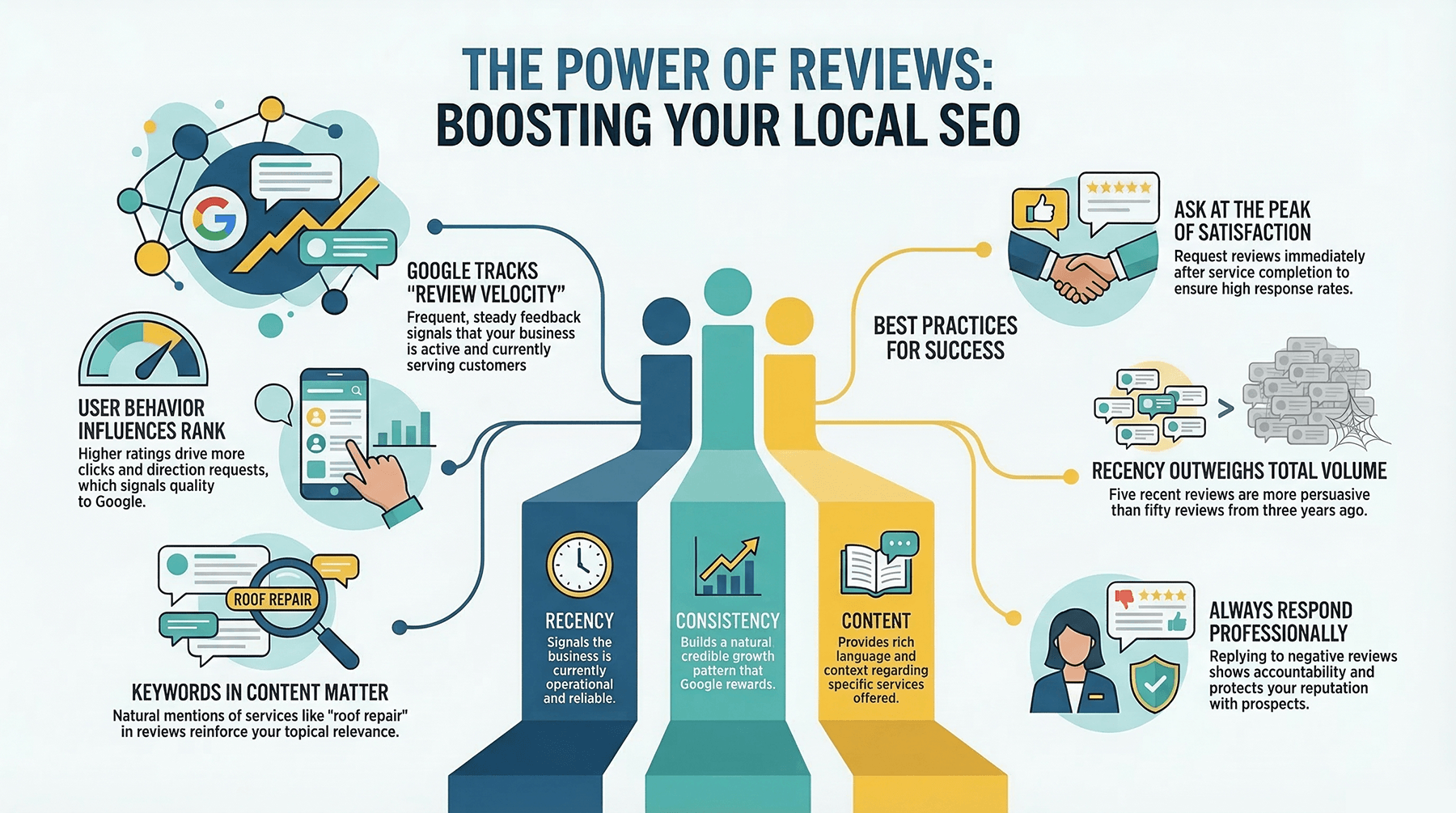
Key takeaways:
- Google factors review quantity, velocity, diversity, and sentiment into local visibility, not just the star average.
- Recency beats volume. A few recent reviews carry more weight than a pile of old ones.
- When customers naturally mention your services or location, that language supports local relevance.
- Negative reviews don't automatically hurt rankings. The pattern and your response matter more.
- Buying or faking reviews is a losing bet. Detection has improved and the reputational cost is worse than the gain.
- Make the ask easy. A direct link to your Google Business Profile after a completed job converts best.
- Reviews amplify the rest of your local SEO. They don't replace it.
If two local businesses offer the same service at a similar price, most customers decide fast. They check the star rating, skim a few recent reviews, and pick the one that feels safer.
Google watches that behavior too.
So the short answer is yes, though not in the way most owners hear it. Reviews aren't a switch that lifts a company to the top of local search overnight. They're one of several trust and relevance signals that improve visibility, click-through rate, and conversions once people find you.
That distinction matters. Expect reviews alone to carry your rankings and you'll be disappointed. Use them as part of a broader local SEO strategy and they become a real advantage.
Watch the companion video: Do online reviews help local SEO?
The ranking effect is both direct and indirect
Google has long indicated that review signals factor into local ranking: quantity, velocity, diversity, and sentiment. In plain terms, Google notices whether you get reviews, how often, what customers say, and where those reviews appear.
That doesn't mean the business with the most reviews always ranks first. Proximity, Google Business Profile optimization, website quality, local relevance, and links still matter. A closer competitor with a better profile can outrank a business with more reviews.
Reviews still strengthen local SEO in several ways. They give search engines more context about your business. They create fresh customer-written content tied to your brand. They reinforce service terms when customers mention what they hired you for. And they build trust, which improves the engagement signals that support local performance over time.
Why reviews move local visibility
A review is a public record that a real customer dealt with your business.
Search engines want to recommend local businesses that look credible, active, and relevant. Reviews cover all three. A steady stream of recent feedback tells Google you're operating and serving customers now rather than sitting on an outdated profile.
The wording inside reviews counts too. When customers repeatedly mention "roof repair," "family dentist," or "emergency plumbing," those terms reinforce what you're known for locally. Never script keyword-heavy reviews, but authentic customer language does real work.
Then there's the behavioral effect. Two businesses in the same local pack won't get the same clicks. The one with the stronger rating and review profile usually wins them, and more clicks, calls, and direction requests signal that users prefer that listing.
Which reviews carry the most weight
Owners tend to fixate on the star average. It matters, but it's not the whole picture.
Recency counts. Ten glowing reviews from three years ago persuade less than five strong ones from the last two months. Search engines and customers both want to know whether your reputation is current.
Consistency counts too. A business earning reviews steadily looks healthier than one that got twenty in a week and then nothing for a year. Spikes happen naturally after a busy season or a campaign, but an even pattern reads as more credible.
Content matters. "Great service" helps. A detailed review helps more, because it tells the next customer what to expect and gives search engines richer language about your services and location.
Platform spread helps as well. Google reviews are the priority for local SEO and map visibility, but reviews on industry platforms and major directories reinforce your reputation across the web. In some industries those sites carry real weight with customers even when they don't move rankings much.
What negative reviews actually do
Not what most owners fear.
A few negative reviews won't wreck your rankings. A profile with nothing but perfect five stars can even look suspicious, since most customers expect some variation. The pattern and your response matter more than any single review.
Negative reviews become a problem when they're frequent and keep naming the same issue. That costs conversions because prospects lose confidence, and it usually points at a real service problem that will show up in your results eventually.
Responding well softens the impact. A calm, professional reply shows customers and search engines that your business is accountable. You don't need a long defense. Acknowledge the issue, stay respectful, move toward resolution.
That won't erase the review, but it protects trust better than silence does.
Building a review process that runs
The most effective approach is simple, consistent, and realistic for your team.
Ask as part of your normal customer process, at the right moment: after the job is finished or when the customer says they're happy. Wait for people to remember on their own and volume stays low. Ask too early and the review feels forced.
Keep the request frictionless. Send customers straight to your Google Business Profile review link. Every extra step costs you responses.
Train your staff so reviews don't depend on the owner remembering. Anyone who talks to customers should know when and how to invite feedback naturally.
Respond consistently. Thank the happy ones, address the concerns professionally.
Then read what the reviews tell you. If customers keep praising one service, that's marketing language for your website and profile. If they keep flagging the same problem, that's an operations fix.
Mistakes that limit what reviews can do
The biggest one is chasing reviews without improving the business behind them. Local SEO works best when reputation reflects reality. A weak website, inconsistent listings, poor service, or a half-finished Google Business Profile won't be solved by more reviews.
Another is asking everyone at once and then stopping. Review generation should be ongoing.
Some businesses overcomplicate it: sending customers to multiple platforms, burying the request in a long email, never following up. If you want reviews, make the action obvious.
And then there's cutting corners. Buying reviews, posting fake feedback, or pressuring employees and friends into dishonest ratings is risky. Platforms detect manipulation better every year, and the reputational damage costs far more than any short-term lift.
So how much should you prioritize them?
A lot, with the right expectations.
If your business depends on local visibility, reviews influence both rankings and revenue. They make you look credible in search, improve the odds someone clicks your listing, and support conversion after the click.
They still aren't a substitute for the fundamentals. You need a well-optimized Google Business Profile, accurate business information, a solid website, local content, and a clean technical foundation. Reviews make those stronger.
That's where momentum comes from. A stronger profile earns more clicks. More clicks bring more leads. More leads create more chances for satisfied customers to leave reviews. Over time that loop compounds.
If your local visibility is flat, reviews may not be the whole problem, but they're usually part of the fix. The businesses that win local search are the ones that look trustworthy before anyone visits the website.
FAQs
Do online reviews help local SEO?
Yes. Reviews influence local rankings through signals like quantity, recency, velocity, and sentiment. They also create customer-written content tied to your brand, reinforce service terms, and improve the engagement metrics that support local visibility over time.
Which review platform matters most for local SEO?
Google reviews are the priority for local rankings and map pack visibility. Reviews on industry directories and major platforms reinforce your broader reputation, but Google is where the most direct ranking impact happens.
How many reviews do I need to rank in local search?
There's no set number. Consistency, recency, and overall sentiment matter more than total count. A business earning reviews steadily tends to outperform one with a large but stagnant total.
Do negative reviews hurt my local SEO?
Not automatically. A few negative reviews are normal, and an all-perfect profile can look suspicious. What matters is the overall pattern and your response, since a calm professional reply protects trust and shows accountability.
How do I get more Google reviews without buying them?
Ask right after a job is complete or when a customer expresses satisfaction, and send a direct link to your Google Business Profile review page. Train your team to invite feedback naturally and make the request part of standard follow-up.
Can review content affect which keywords I rank for?
Indirectly. When customers mention specific services, locations, or outcomes on their own, that language reinforces topical relevance. Never script keyword-heavy reviews, but authentic customer wording supports the signals Google uses.