
TL;DR: Most local businesses don't have a traffic problem. They have a conversion problem. These eleven ideas work because they connect into a system that moves buyers from searching to trusting to contacting you, instead of firing off disconnected tactics and hoping. Start with your Google Business Profile and your service pages, tighten the forms, and answer inquiries fast.
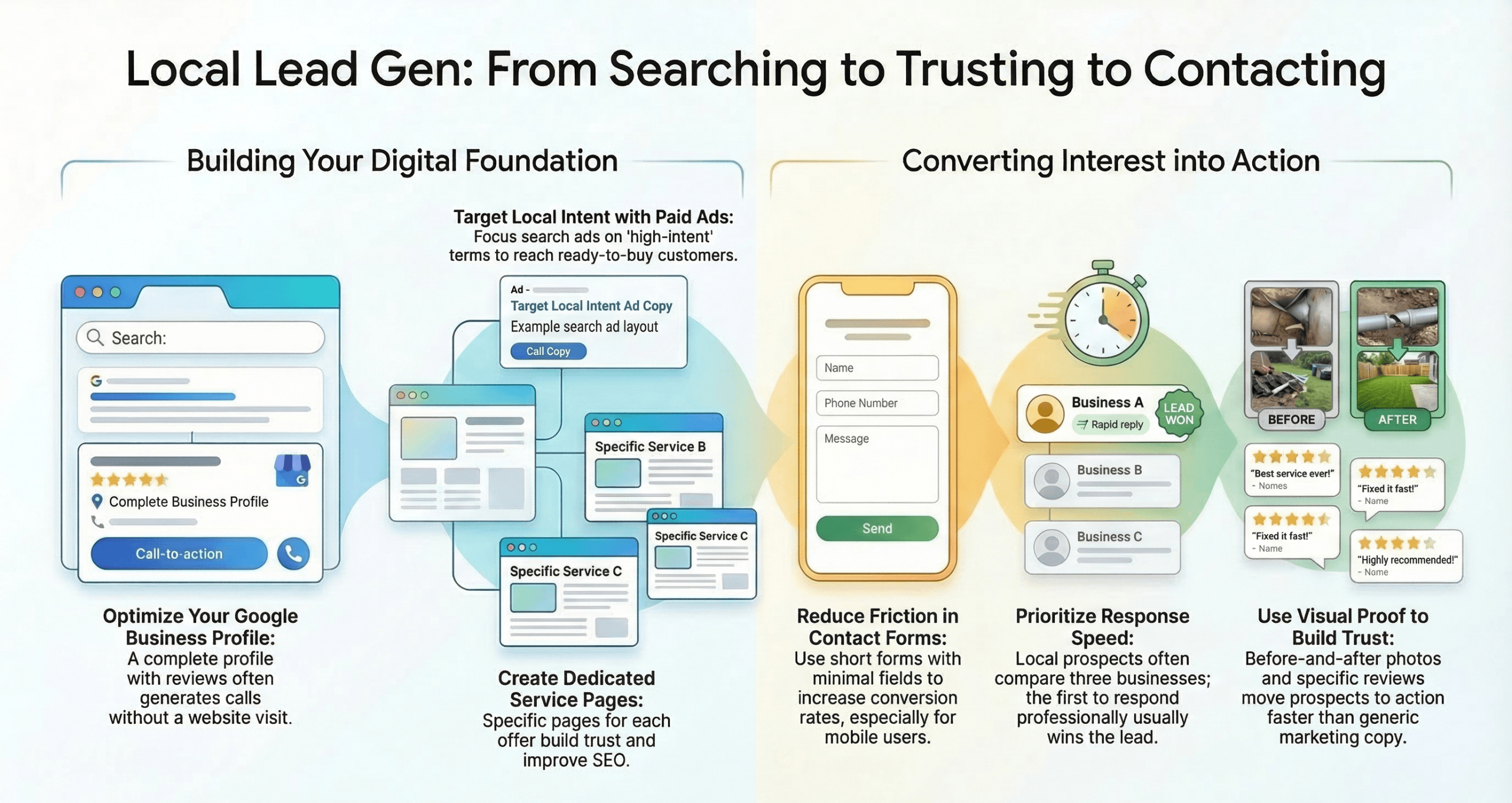
Key takeaways:
- Lead generation is a system. Every element has to answer why a buyer should choose you now.
- Google Business Profile is the highest-ROI starting point. It often produces calls before anyone reaches your website.
- Service pages outperform homepages in local search. Each core offer deserves a focused page with one clear next step.
- Reviews are conversion content. Specific, outcome-driven reviews reduce buying risk.
- Short forms convert better than long ones, especially on mobile.
- Follow-up speed wins jobs. Local prospects compare several businesses at once.
- Existing customers are an underused lead source, and a cheaper one than cold acquisition.
- Fix conversion before chasing more traffic. Small changes to calls to action, page speed, and follow-up raise lead volume without a bigger ad budget.
Plenty of owners build a website, claim their Google Business Profile, post on social for a few weeks, then wonder why the phone stays quiet. Effort usually isn't the problem. Lead generation is being treated as a pile of random tactics instead of a system.
These ideas work when they help buyers move from searching to trusting to contacting you. Every tactic has to answer one question: why should someone choose your business now instead of calling the next listing down?
Watch the companion video: 11 lead generation ideas that work local
What makes local lead generation different
You aren't trying to reach everyone. You're trying to reach people in a specific service area who already have intent.
That changes the playbook. A roofing company, med spa, law office, or home services brand doesn't need vanity traffic from across the country. It needs qualified calls, form fills, booked consultations, and direction requests from people nearby. The closer your marketing stays to real buying intent, the better your return.
It also means speed matters. Local prospects often compare three businesses at once. An incomplete profile, a slow website, or a day-long response time can lose the lead before you know it existed.
1. Turn your Google Business Profile into a lead source
For many local companies, the profile is the first impression that counts. It shows up before your website does, and sometimes it generates the call on its own.
A strong profile needs accurate categories, service areas, current hours, quality photos, a full services list, and regular updates. Reviews carry a lot of weight here. When two businesses look similar, the one with stronger recent reviews gets the click.
This is one of the highest-ROI moves available because it meets customers at the moment they're searching. In competitive markets like Amarillo or Lubbock, profile quality decides whether you're visible or skipped.
2. Build service pages for each core offer
A homepage alone rarely converts well in local search. People want a page that matches their exact need. If you offer HVAC repair, AC installation, and maintenance plans, each one deserves its own page.
That helps SEO, and it helps conversions more. A focused page can answer questions, show trust signals, and present a single next step. Generic pages attract weaker traffic and create hesitation.
The trade-off is time. Thin pages written to fill space won't perform. A few strong pages beat a dozen rushed ones.
3. Create location pages where they make sense
If you serve multiple cities or neighborhoods, location pages can capture strong local intent. The operative phrase is where they make sense. If every page says the same thing with the city name swapped, users and search engines both notice.
A good location page covers the services offered there, what local customers typically need, proof you actually serve the area, and a direct path to contact your team. This works best for businesses with multiple service zones, mobile crews, or genuinely distinct local markets.
4. Use reviews as conversion content
Most owners understand reviews matter. Fewer treat them as part of lead generation.
Reviews reduce risk. They answer the unspoken concern every buyer has: will this business do what it says? Collect them consistently, respond professionally, and feature them on the pages where people decide to contact you.
It helps to nudge customers toward specifics. "Great service" is nice. "They fixed our AC the same day and explained the cost clearly" sells.
5. Offer one strong lead magnet if your sales cycle is long
Not every local lead is ready to call today. For higher-consideration services like legal work, medical aesthetics, remodeling, or business services, a lead magnet captures interest earlier.
A pricing guide, a local buyer checklist, a consultation prep sheet, or a short email series answering common questions. The best version is practical and tied to the decision the prospect is already working through.
If you run a fast-intent service like emergency plumbing, this matters less. If your buyers compare options for weeks, it matters a lot.
6. Tighten your forms and calls to action
A surprising number of local websites ask for too much too soon. Long forms create friction, especially on mobile. Most prospects don't want to write an essay to ask whether you're available.
Keep forms short. Name, contact information, and one field for the request is usually enough. Pair that with clear calls to action throughout the site instead of only on the contact page.
Small changes here raise lead volume without adding a single visitor. That's why conversion work often beats chasing traffic.
7. Run local ads built around intent
Paid search works well for local businesses when campaigns target high-intent terms: service plus city, emergency needs, quote-related searches.
The mistake is sending all that traffic to a generic homepage or bidding too broadly. Good campaigns match keyword, ad copy, and landing page, and they track what happens after the click.
Paid isn't always the cheapest channel, especially in competitive industries. When your margins support it and your landing pages are solid, it produces leads quickly while SEO builds.
8. Add text or chat for mobile users
Some people want to call. Many would rather text, especially during work hours. A fast, low-friction way to ask a question recovers leads who would otherwise leave.
This only works if someone actually monitors it. An unanswered chat tool does more harm than none at all. If your team can't keep up with live chat, a well-placed text option is easier to maintain.
9. Build an email and SMS follow-up system
Lead generation doesn't stop when the form is submitted. For a lot of local businesses, the money leaks out of weak follow-up.
New inquiries should get a response within minutes during business hours. Beyond that, you need simple sequences for estimates, consultations, and past customers. A reminder, a check-in, or a limited-time offer can revive leads that looked cold.
This matters even more when your close rate depends on timing. The first business to follow up clearly and professionally usually wins.
10. Show before-and-after proof
Local buyers trust visible evidence. Before-and-after photos, short case studies, project snapshots, and transformation stories move a lead toward action faster than marketing copy.
For service businesses that means project galleries. For health, beauty, or dental brands it means treatment results with patient-friendly explanations. For professional services it can be process-based proof, outcomes, or client scenarios that keep sensitive details out.
Strong proof makes your claims believable, and believable claims generate inquiries.
11. Stay visible after the first sale
One of the best lead sources is the one you already paid for: your existing customers.
Post-service review requests, referral prompts, seasonal check-ins, reactivation campaigns, helpful follow-up content. Existing customers convert faster, cost less to reach, and refer more often when the experience went well.
Many owners chase new leads while ignoring the list they already have. That's usually a mistake.
How to choose the right mix
Not every tactic belongs in every business. A restaurant may lean on Google Business Profile, reviews, and social proof. A home services company may get more from service pages, paid search, and fast response systems. A medical or legal practice may need stronger landing pages, educational content, and structured follow-up.
The question isn't which tactic is most popular. It's which one removes the most friction for your buyers.
That lens produces better decisions than copying whatever another business claims is working. At 11 Marketing + Design, this is usually where local businesses see the biggest shift: once the website, local SEO, and conversion points work together, lead generation gets predictable instead of frustrating.
If you want more leads, start by fixing the path between interest and action. That's where the growth is hiding.
FAQs
What is local lead generation?
Local lead generation attracts and converts potential customers within a specific geographic service area. It focuses on people who already have buying intent and are searching nearby, turning that interest into calls, form fills, booked consultations, and direction requests.
What is the most effective lead generation strategy for local businesses?
There's no single best tactic. The most effective strategy removes friction between interest and action for your specific buyers. For most local businesses that means an optimized Google Business Profile, strong service pages, consistent reviews, and fast follow-up working together.
How does Google Business Profile help with lead generation?
The profile often appears before your website in local results and can generate calls, direction requests, and site visits on its own. Accurate categories, current hours, quality photos, a full services list, and strong recent reviews put you in front of prospects at the moment they're searching.
Why do local businesses lose leads even when they get traffic?
Usually conversion problems: slow load times, long or complicated forms, unclear calls to action, slow follow-up, and missing trust signals like reviews and proof of work. Fixing those points often raises lead volume without any increase in traffic.
How important is follow-up speed?
It's critical. Local prospects compare several businesses at once, and the first to respond clearly and professionally frequently wins the job. New inquiries should get a response within minutes during business hours.
How can existing customers generate new leads?
Post-service review requests, referral prompts, seasonal check-ins, and reactivation campaigns generate new business at a lower cost than cold acquisition. Customers who had a good experience convert faster and refer others when prompted at the right moment.