
TL;DR: Most service businesses don't have a visibility problem. They have a relevance problem. Your Google Business Profile categories tell Google what your business actually is, which decides the searches you appear for, the lead quality you get, and the competitors you're ranked against. Pick a primary category that matches your main revenue driver and how customers actually search, add secondaries only for real, promoted service lines, and revisit the setup as the business changes.
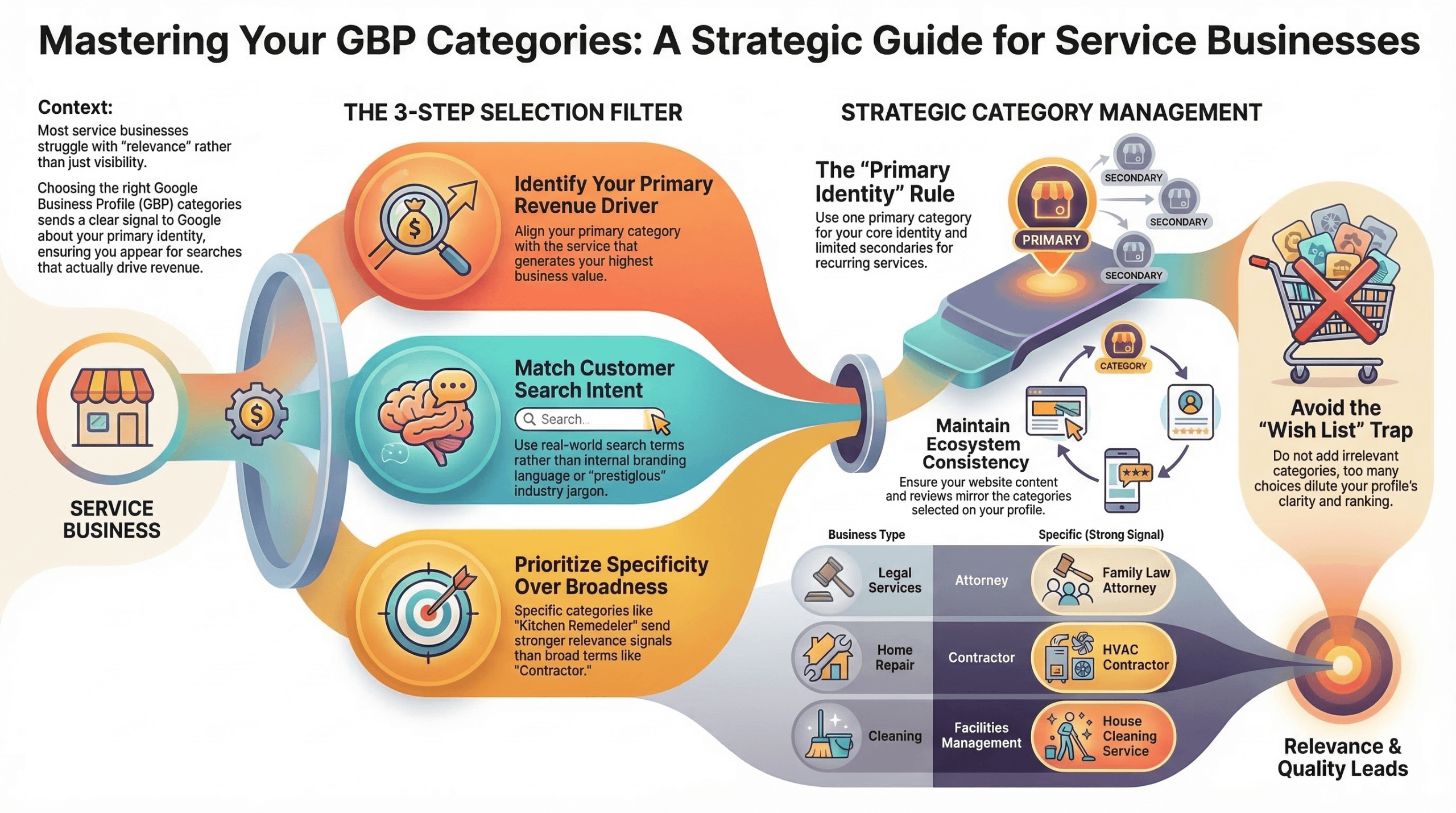
Key takeaways:
- Your primary category is your most important ranking signal. It should reflect your highest-value service, not a broad label that tries to cover everything.
- Match how customers search, not how you describe yourself internally.
- Specific beats broad when it's accurate. "Family law attorney" outperforms "Attorney" if family law is what you do.
- Secondary categories should support the primary story, not compete with it.
- More categories is not better. A focused set outperforms a long, unfocused list.
- Categories don't work alone. Your services, description, website, and reviews need to tell the same story.
Watch the companion video: How to pick service GBP categories
If your profile shows up for the wrong searches, or doesn't show up when buyers are clearly looking for what you do, categories are one of the first places to look. The setting seems small, but it helps Google decide when your business fits a local search. Pick well and you improve visibility, lead quality, and conversion. Pick poorly and you can rank for traffic that never turns into revenue.
Choosing categories isn't about finding a clever workaround. It's about sending a clear signal. Google wants to understand your primary service, your real business model, and the searches you deserve to appear for. Your job is to make that easy.
Why categories matter more for service businesses
Categories affect how Google interprets your business: the searches you may appear for, the features available on your profile, and the local competitors placed around you. In crowded service markets, a slight relevance edge changes who gets the call.
A restaurant or retail store usually has a simple categorization path. A service business often doesn't. An HVAC company may offer repair, installation, indoor air quality, and maintenance plans. A law firm may handle family law, estate planning, and mediation. A marketing agency may offer SEO, website design, and profile optimization. All of that is real, but Google still wants a primary identity.
This is where owners get stuck. They try to represent every service equally and the profile dilutes. The stronger move is almost always the same: choose the category that matches your highest-value core service, then use secondaries to support the full picture.
Start with your primary revenue driver
The first step isn't inside Google Business Profile. It starts with your business priorities.
Ask a practical question: if one ideal customer searched for one thing today, what would you most want to be found for?
That answer should drive your primary category. Not every service deserves top billing. If 70 percent of your revenue comes from roof replacement, "Roofing contractor" will usually beat anything broader. If you're a med spa known primarily for injectables, the main category should reflect that identity rather than a long list of related treatments.
Your primary category should align with what drives the best business, not what sounds broad enough to cover everything.
Match search intent, not internal language
Owners often describe their company one way while customers search another. That gap produces weak category choices.
You may think of your company as a "property improvement specialist," but if customers search for painters, remodelers, flooring contractors, or landscapers, your category needs to use those terms. Categories work when they mirror real search behavior, not branding language.
If you've ever wondered why a competitor with a less polished website keeps showing up in local results, category alignment is one likely reason. Google rewards clarity.
Be specific when the specific category truly fits
Broad categories help when your services are genuinely broad, but specific categories send a stronger relevance signal.
"Attorney" is technically accurate, but "Personal injury attorney" or "Family law attorney" works far better if that's what you actually do. "Contractor" is valid; "Kitchen remodeler" or "Electrician" is stronger if those are your main services.
The trade-off is simple. Specificity improves relevance only when it honestly reflects your core business. Stretch into a niche category for a service you rarely provide and the misalignment hurts more than it helps.
Primary vs. secondary categories
Your primary category carries the most weight. Secondaries fill out the profile, but they should support the main story.
Keep the set focused. A plumber who also does bathroom remodeling might run "Plumber" as primary and "Bathroom remodeler" as secondary, if that service is established and promoted. If remodeling is a minor add-on, the extra category may not be worth the confusion.
Secondary categories earn their place when they reflect distinct, recurring service lines. They stop earning it when they become a wish list.
Some businesses legitimately span several strong categories: pest control plus wildlife removal plus insulation under one brand, or a digital agency offering website design, internet marketing, and SEO. Multiple categories can make sense when they reflect real operational divisions. Even then, restraint wins. The profile should still answer one question clearly: what is this business first?
Common category mistakes that cost leads
Copying competitors without checking fit. Competitor research is useful; blind copying is not strategy.
Picking a category because it sounds prestigious or broad. Google isn't awarding points for sophistication. It's connecting a searcher to the most relevant result.
Never revisiting categories as the business evolves. Businesses add profitable specialties, drop low-margin work, and reposition. A category setup from three years ago may be holding back current growth.
Stacking overlapping categories. When two categories describe the same practical service, use the one that best matches your market and move on. The rest is noise.
A practical way to make the right choice
Narrow your options with three filters. Which category best reflects your main profit center? Which category matches the phrase your best customer is most likely to search? And do your website, services, and profile content all support that choice?
That last filter matters more than most businesses realize. Google also reads your services list, business description, website content, and reviews. If your primary category says one thing and your website emphasizes something else, your positioning weakens. The strongest profiles are consistent across the board.
Examples by service type
A residential HVAC company should usually lead with "HVAC contractor" if heating and cooling is its core revenue, adding "Air conditioning repair service" or "Heating contractor" where those reflect significant work.
A law office focused on divorce and custody should choose "Family law attorney" over the broader "Law firm."
A home cleaning company usually does better with "House cleaning service" than a facilities-related category, especially when residential search intent drives the business.
A marketing agency has to weigh "Marketing agency," "Internet marketing service," and "Website designer" against what it most wants to rank for and which service line produces the best returns.
There's no universal list of best categories for service businesses. The right answer depends on your business model, your market, and your growth goals.
What to do after you update categories
Give the rest of the profile the same precision. Build out your services fully, make the business description reflect your core offerings, and keep your website landing pages on the same themes. Reviews that mention your primary services in natural language reinforce all of it.
Then watch performance. If visibility improves but lead quality drops, the category may be too broad. If lead quality is strong but impressions are low, you may need a more specific setup. Small adjustments here produce real local SEO gains.
For service businesses competing in crowded markets, category selection isn't filler. It's strategy. If your profile isn't attracting the right searches, start there, tighten the signal, and let Google understand exactly what you do best.
FAQs
Why do Google Business Profile categories matter for service businesses?
Categories tell Google what your business is, which influences the searches you appear for, the features available on your profile, and the competitors you're ranked against. In crowded service markets, that relevance signal often decides who gets the call.
How do I choose my primary Google Business Profile category?
Identify your primary revenue driver, the one service you most want your ideal customer to find you for. The primary category carries the most ranking weight, so it should match that service and the way customers actually search for it.
How many categories should a service business use?
There's no correct number, but restraint outperforms volume. Add secondaries only for distinct, recurring service lines that your website actively supports. A focused set typically beats a long, unfocused list.
Should I use specific or broad categories?
Specific categories send a stronger relevance signal when they honestly reflect your core service. "Family law attorney" usually beats "Attorney." Stretching into a niche you rarely serve creates misalignment that hurts performance.
Do categories affect which features appear on my profile?
Yes. Google unlocks certain features based on your primary category, including booking buttons, service menus, and category-specific fields. An accurate primary category gives you the features most relevant to your business type.
How often should I review my categories?
Any time your business model meaningfully changes: a significant new service line, dropped work, or repositioning. An annual review is a good baseline to keep categories aligned with current revenue priorities.